

First Jägermeister
Jägermeister is herbal hell for some and party central for others. A spirit that is simultaneously described as a liqueur, a digestif, a medicine and a student rite of passage. As a drink, it’s intriguing and confusing in equal measure. It doesn’t have a trendy bottle, its name is hard to say, no one is 100% sure what’s in it and its history comes with a hint of Nazism. Curious to know more?

Jägermeister was first pioneered and perfected by an entrepreneur called Curt Mast in the sleepy northern German town of Wolfenbüttel in 1934 but only sold commercially a year later.

Depending on how good your history is, you’ll know that 1934 was a year of radical, terrifying, history-defining politics in Germany. With the world reeling from the Great Depression, the Nazi Party had risen, thrived and threatened the nation into becoming a one-party state by July 1933. Adolf Hitler, Chancellor at the time, later proclaimed himself Führer (‘leader’) in August 1934, the dictator of Germany with absolute power.
This was the chilling backdrop to the birth of Jägermeister; the controversial canvas on which the world’s most popular liqueur was first sketched out. Germany was on its knees. The economy had collapsed. One in three Germans were out of work. World War I reparations were crippling, causing widespread poverty all over the country. And Wolfenbüttel, like thousands of other provincial towns, was not immune to the turmoil.

Curt Mast was the owner of a local wine and vinegar business, and he was up to his eyeballs in debt. If he didn’t find a way out of the economic gloom, the business his father had built and he’d taken on would be swallowed up and lost, like so many others around him. He knew that turning to the established banks wasn’t an option (they weren’t lending), so he had to rely on his instincts and ingenuity.
But before we find out how and where Curt’s inspiration struck (it’s worth the wait), let’s rewind a little to find out more about the Mast family history.
Curt’s father was the first entrepreneur in the family. Christened Heinrich Friedrich Wilhelm Mast, but forever known as Wilhelm, he was born in the tiny picturesque, mountainous village of Wieda on 24th August 1846. Aged 19, Wilhelm made his way to the comparatively bustling town of Wolfenbüttel (today, about an hour’s drive away) to make his fortune. For over a decade, he worked as a clerk until he’d saved enough money to set up his own business, a vinegar making company, on 23rd July 1878, headquartered at Großer Zimmerhof 26.

Starting a vinegar business might sound pretty niche, but it was a canny idea for the time. Boasting a host of hills and mountains, the Lower Saxony region was somewhat economically reliant on the mining industry – of which vinegar was a strangely important ingredient. In hard-to-reach metal ore tunnels or shafts, where dynamite was impractical or too expensive, miners used an ancient technique known as ‘fire setting’. They’d light a fire directly against the rock face and once sufficiently heated, vinegar was thrown onto the surface to cause fast cooling. The acidity of the vinegar increased the thermal shock, producing deeper cracks and making it easier for miners to extract valuable ores by hand. This was how Wilhelm thought he’d make his mark and his fortune.
Unfortunately for him, the industrial revolution reached Lower Saxony! Vinegar production quickly became industrialised and large-scale, with inexpensive spirit vinegar being produced all over the country. Wilhelm was forced to pivot fast – he borrowed money and started buying and selling wines to supplement his income.
But responsibilities were mounting in Wilhelm’s personal life too. He married 18-year-old Emma Fricke on 14th November 1878 and proceeded to have an astonishing 12 children in quick succession. Curt was the 11th child and the fourth son, born on 26th March 1897 in Wolfenbüttel. Sadly, he barely had time to get to know his mother, who died in childbirth before he turned three.
But the family and the company hung on. Wilhelm stayed strong-willed and imparted a clear vision for the future roles for his sons: Wilhelm Junior was to take over the business as the eldest surviving male (he was five years older than Curt). To this end, in June 1908, aged 17, he was sent to Hildesheim – about 50km away – to complete a four-year apprenticeship as a wine merchant and distiller at the C.H. Meyer company. In contrast, Curt was sent to Wolfenbüttel teacher training college, where he graduated in October 1916, slap bang in the middle of World War I.
But with his brother now conscripted and away fighting, Curt got more involved in his father’s business than planned, making himself indispensable from the age of 16 onwards. Around this time his father had a stroke, hugely impairing his ability to work, and the company almost had to foreclose, but Curt helped keep it afloat. In recognition of his loyalty and hard work, Curt Mast was registered as the owner of the company on 25th June 1917. For context, this was a month after the USA entered the war, a month before the Third Battle of Ypres and still a year before peace was signed.
Wilhelm father passed away on 5th June 1918, aged 71, leaving the 21-year-old Curt fully in charge. One of the first things Curt did was stop vinegar production to focus on wine. Even so, trade proved extremely tough, so he trusted in his entrepreneurial nature and started tinkering with a host of alcoholic adjacencies, most notably a kräuterlikör, the generic term for a German herbal liqueur used for centuries as a medicine.

As he experimented in his spare time, he also sought to publicly raise his status in Wolfenbüttel by entering local politics in the aftermath of World War I. He started his career as a city councillor for the German People’s Party (DVP), a conservative-liberal party, and ended it as leader of the CDU (Christian Democratic Union) in the district council. Yet on 1st May 1933, we know he joined the Nazi Party (ID number 3183016). The Nazi stranglehold on democracy had begun in earnest and Curt was obliged to join the Party to continue his political mandate and ward off any unwanted attention. Nine days after he joined, public burnings of ‘un-German’ books, written by Jewish and left-wing writers, took place in cities across Germany, most famously in Opernplatz (now Bebelplatz) in Berlin.
Shortly after, the city council even honoured Hitler as an honorary Wolfenbüttel citizen – a political decision Curt had presumably been involved in. The original fawning telegram read:
“The city council of Wolfenbüttel, Lessing's city, which is resplendent in its spring decorations and is composed entirely of National Socialists, has decided to confer honorary citizenship of the city of Wolfenbüttel upon the Führer, whom they revere with unwavering loyalty.”
But as we’ll see, his time as a politician gave him a rare insight into how he should and could promote his new liqueur in a nation run by fear, violence and intimidation.
A year later, in 1934, Curt perfected the recipe for his own special kräuterlikör. Now all he had to do was bottle it and brand it. But what to call it? It was a decision that could make or break the success of the spirit and the business, and not one to be taken lightly.

On 3rd July that year, a new Nazi law gave him an idea. The Reich Hunting Law (Reichsjagdgesetz) was passed that unified hunting regulations across the country and appointed the ever-powerful Hermann Göring as Reichsjägermeister, or Germany’s Master of the Hunt. As Hitler’s right hand man, Göring’s rise to power was as staggering as it was rapid. In January he was made Minister of the Interior for Prussia (a region that included Wolfenbüttel within it). In April he established the Gestapo, the ruthless secret state police. In May he took control of the Reich Air Ministry, which later became the Luftwaffe. Excepting Hitler himself, he was almost certainly the most powerful man in Germany at the time.
While on the surface, the new law aimed to regulate national hunting practices and promote conservation, it was also used for propaganda purposes. The Nazis were big on using strong animal symbolism, and the stag – which Göring had chosen to represent the German Hunting Society – was the perfect fit. Long revered in Europe as a sign of strength, virility and nobility, the Nazis started using it for connotations to a ‘master race’. And with hunting traditionally the pursuit of kings, symbolising power and skill, the Nazis gladly adopted it for their own nefarious ends.

So in late 1933, Göring had created a series of regional jägermeisters (master hunters) to implement his laws, with him ruling over them. The emblem he chose to represent his German Hunting Society was a stag with a swastika between its horns, surrounded by a celestial sunburst. The logo was used on flags, membership pin badges, daggers and plaques. It was everywhere – and anyone who wanted to hunt had to be a member to get their licence.
The thing is, Curt Mast loved hunting – and to be fair, it was a passion for most people who lived in the Lower Saxony region. They had unrivalled access to ancient forests and rivers, so hunting was a tradition that had been passed down and enjoyed for generations.
In a stroke of marketing genius, he named his new herbal liqueur Jägermeister. It was a word, as we’ve seen, that was already widely used, that represented excellence, that aligned with his hobby and was ‘approved’ by the political hierarchy. It was even a rather obvious genuflect to Göring, who became a near neighbour of Curt’s in the same year. In 1934, Göring started building his own hunting lodge – called Reichsjägerhof – in Riddagshausen near Braunschweig, which is about 16km or a 25-minute drive from Wolfenbüttel.
With the name sorted, Curt turned his attention to the bottle and logo. It’s said that he wanted a sturdy, high-quality glass – one that could withstand the rigours of being taken out into the wilderness while hunting – so he put several different shapes and models through his own ‘breakage’ test. Anecdotal stories claim he would drop each one onto the wooden floor in his kitchen at home to see which one survived – hence why he ended up with the iconic square bottle we know today.
For a logo, Curt chose exactly the same emblem as Göring’s German Hunting Society – but with one crucial difference. He replaced the swastika between the stag’s horns with a Christian cross (phew).
The cross, in fact, was far more historically accurate to the original legend of St. Hubertus, universally renowned as the patron saint of hunters.

The image depicts the legend of Saint Hubert of Liège, a 7th-century Christian saint and bishop known as the Apostle of the Ardennes.
The story tells of Hubert, a nobleman and avid hunter, whose beloved wife died in childbirth while delivering their son Floribert. Struck by a terrible grief, he retreated from the court and withdrew into the forests of the Ardennes. On Good Friday morning, while the faithful were in church, Hubert was hunting, on the tail of a magnificent white stag. But then came the divine intervention. As Hubert drew his bow, the stag turned towards the hunter – who was astounded to see it had a crucifix floating between its horns, before hearing it utter the words: “Hubert unless thou turnest to the Lord and leadest a holy life, thou shalt quickly go down into Hell”. Of course, after this vision, Hubert renounced his wealth, became a priest and was later made the first bishop of Liège in 708 AD. Ever since, he has been held in high esteem by hunters, who decode the legend to promote ethical hunting and animal conservation.
Curt doubled down on Jägermeister’s hunting origin story by adding the first stanza from a poem by Oskar von Riesenthal, a German hunter, ornithologist and writer, to the label of all his Jägermeister bottles. The poem was called ‘Waidmannsheil’ (‘Hunter's Salute’), and was widely regarded as a guiding principle for responsible hunting:
“This is the hunter's honour shield, that he protects and cherishes his game, hunts with respect, as it should be, and honours the creator in his creatures.”
Jägermeister proved an instant success, particularly among the military, where it came to be known as ‘Göring-Schnaps’ for obvious reasons. It was a huge relief to Curt, who had worked tirelessly to perfect the unique and layered recipe over the previous year – and it’s credited with saving his business.
The exact recipe of Jägermeister is a closely guarded secret known only to a few individuals, but the current website confirms that ingredients include star anise, cinnamon, liquorice root, bitter orange, chiretta, orange peel, ginger, galangal, clove, mace and cardamom. It’s said there are an astonishing 56 different natural herbs, flowers, roots and fruits used to make it; the reason many claim it to be one of the most complex spirits in the world. There was even an urban myth that the liqueur contained deer blood (untrue), adding to its overall mystique.
It's said that a total of 383 quality checks are performed before the bottles are filled with the 35% ABV spirit. Each ingredient is first precisely measured out before being combined with water and alcohol and left to sit for a few weeks, when the natural oils and flavours seep out. Today, the mixture is then matured in 455 oak casks in the Wolfenbüttel cellars for around a year to add to its depth.
While many consider Jägermeister to be a bitter, its unique semi-sweet taste means it can’t technically be described as such. It’s still enjoyed in Germany as a digestif, where it’s sometimes jokingly referred to as a leberkleister, or ‘liver glue’!
Initially, of course, Jägermeister was marketed to German hunters and outdoorsmen, proving popular with an older demographic in neighbouring countries like Austria, Switzerland and Denmark. After the war, there was relief when the British excused Curt of being a member of the Nazi party (he was a huge advocate for the restitution of Jewish property and promoted the integration of the Eastern refugees), and he was allowed to carry on making his masterpiece.

In the early 1950s, Günter Mast, Curt's nephew, came into the business and later achieved fame when he oversaw Jägermeister becoming the first brand to sponsor a team in the German Bundesliga after the stag logo was added to Eintracht Braunschweig's jersey for the 1973/74 season. The big breakthrough came when it began to be marketed to a younger audience with the sponsorship of rock concerts and music festivals in the 1980s.
Meanwhile, in the USA, it suddenly became a favourite among college students thanks to an eccentric, cigar-chomping New York entrepreneur called Sydney Frank. Unlike everyone else on the planet who were drinking it as a digestif, he saw its potential as a party shot. He ordered his first case in 1974, but his breakthrough came when a New Orleans newspaper described it as “instant Valium”. Sydney says sales went from 10 cases a month to a 1,000. His masterstroke, however, was to hire an army of scantily-clad ambassadors called the Jägerettes (he later added Jägerdudes too) to roam the college clubs with a holster and licence to pour. By 2016, Jägermeister global sales reached 7.1 million cases, with around 25% of them in the USA, the brand’s reputation now firmly established as the heart of the party.

Jägermeister is now something of a cultural icon, firmly associated with parties and celebrations, attracting a raucous, loyal and passionate crowd. In Philadelphia in 2006, the then Mayor John F. Street officially declared 14th November to be Jägermeister Day. In the same year, there’s a story about the band Guns N’ Roses – who apparently love Jägermeister – who cancelled a concert in Maine at short notice when they were told they wouldn’t be able to drink the liqueur on stage.
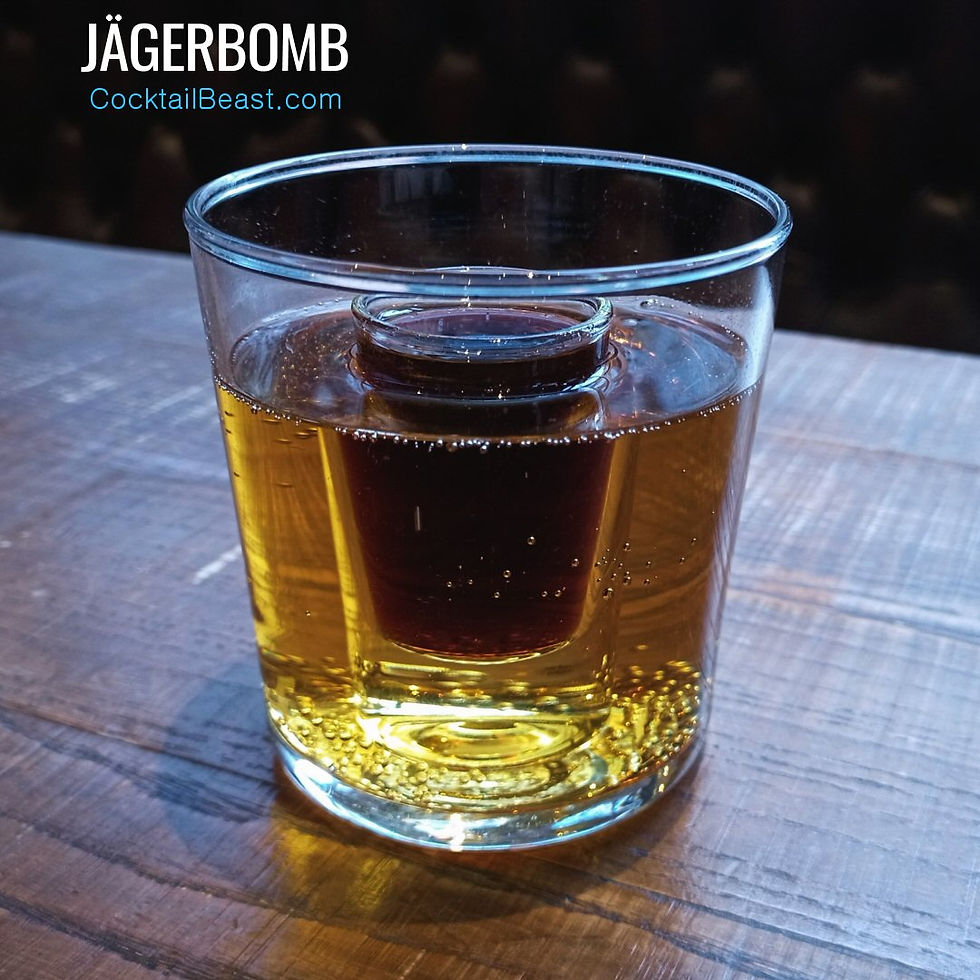
But the story of Jägermeister wouldn’t be complete without reference to Jägerbomb, a ‘uplifting’ mix of Jägermeister and an energy drink (usually Red Bull). No one really knows who, where or when it was officially ‘invented’ but the scant evidence points to it being in the mountains of Northern California in around 1997, where some adventurous snowboarders put two and two together to make what is widely considered to be one of the most frequently ordered bomb shots in bars.
From a sleepy German town in World War II to the trendy black runs of Lake Tahoe, it’s been quite the tumultuous ride for Jägermeister, a drink that saved a family business but has ruined many a night out! When you next hold the bottle in your hands, have a read of the ancient poem still printed on every label and remember it was created as a celebration of nature and the hunters’ moral compass. Now enjoy the shot!


Comments