

First Prosecco

Contrary to popular opinion, Prosecco is far from simply champagne’s cheaper, cheekier younger cousin.
It is something far more interesting; the pride of Italy, revered for 1000s of years, and part of the country’s national and cultural DNA, lauded in poetry and prose for centuries.
But first, the facts. Prosecco is a dry, white Italian sparkling wine made from a blend that’s at least 85% Glera grapes. As a Protected Designation of Origin, it can only be made in nine provinces in the Veneto and Friuli-Venezia Giulia regions of northeastern Italy.

The wine is named after the village of Prosecco (current population about 1,500), which is perched on the coast with incredible views over the Gulf of Trieste, and only a few kilometres from the Slovenian border. The name dates from at least 1308, meaning “path cut through the woods” in the Slovenian dialect (and has been spelled variously as Prossecho, Prosec, Prossegk and Proseck over the years).
Prosecco’s quality can be categorized into two levels: DOC (the standard, produced in any of the nine provinces) and DOCG (the best quality, using grapes specifically from the steep hillside vineyards between Conegliano and Valdobbiadene).
Prosecco is most commonly known as a sparkling wine (spumante) but it can also be semi-sparkling (frizzante) and even still (tranquillo), although rarer. The bubbles are made using the Charmat method, which involves the second fermentation taking place in a large stainless steel tank rather than individual bottles (like champagne). This not only creates its famous ‘fruit-forward’ flavours but is also much faster and more cost-effective, making the wine cheaper than its more famous French counterpart.
But where did Prosecco originate? And who first wrote about the wine? We need to head back to Roman times for our first glimpse at an answer.
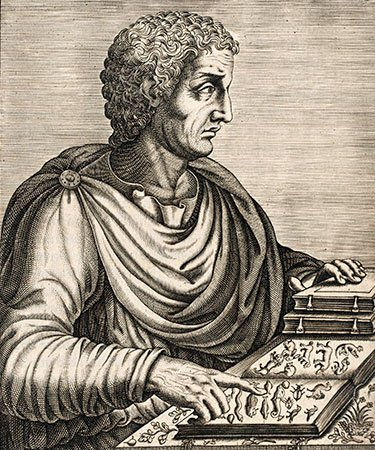
Pliny the Elder was a Roman polymath. His day job(s) included being an imperial administrator, lawyer, cavalry officer and naval admiral. But out of hours, he was a naturalist, philosopher, chronicler and writer. He somehow found enough spare time to write an epic 37-book encyclopaedia about everything from anthropology to zmaragdus (green gemstones, I had to look them up). Called Natural History (Naturalis historia), this magnus opus took him an astonishing 10 years to complete. Honestly, if it wasn’t for him, we wouldn’t know half the things we do about the everyday lives and loves of the Roman civilisation.
As you might imagine, there are a lot of references to wine, famously one of Rome’s most abiding passions. In Book 14, he covers the vine, viticulture and varieties of grape in obsessive detail, including some rather patriotic verses about the superiority of Italian wine: “Supremacy in respect of the vine is to such a degree the special distinction of Italy that even with this one possession she can be thought to have vanquished all the good things of the world”.
Flick to Chapter 8 and he gets to the detail most relevant and notable to Prosecco:
“Who can doubt, however, that some kinds of wine are more agreeable than others, or who does not know that one of two wines from the same vat can be superior to the other, surpassing its relation either owing to its cask or from some accidental circumstance? And consequently, each man will appoint himself judge of the question which wine heads the list. Julia Augusta gave the credit for her eighty-six years of life to the wine of Pizzino, having never drunk any other. It is grown on a bay of the Adriatic not far from the source of the Timavus, on a rocky hill, where the breeze off the sea ripens enough grapes to make a few casks; and no other wine is considered more suitable for medicinal purposes.”

There’s a bit to unpack here. The “wine of Pizzino” is now known to have been Pucinum (but often translated as Pizzino or Pucino), a much-esteemed dry white wine from the 1st century AD, likely made from the Glera grape. It’s widely considered the ancestor of modern Prosecco. “Timavus” refers to a series of natural streams and underground springs in the municipality of Trieste in Italy's northeastern Friuli-Venezia Giulia region, just by the modern village of Prosecco. “Julia Augusta”, also known as Livia Drusilla, was the influential and often scheming wife of Augustus, the first Roman emperor. “Eighty-six years” was a ripe old age for Roman times, where a woman’s life expectancy was more likely around 50 years old. “Medicinal purposes” Pliny claims Pucinum had special health-giving qualities, and it’s later known to have been rich in polyphenols, a type of antioxidant.
So, Pliny the Elder became the first person to write about the wines of Prosecco, albeit known by another name, in AD 77. Incidentally, Pliny died two years later, in AD 79, overcome by sulphur fumes on the beach while attempting to rescue people by sea during the eruption of Mount Vesuvius. Legend.
The first proper written reference to the Prosecco we know today didn’t happen for a good few centuries afterwards.
An English gentleman who went by the wondrous name of Fynes Moryson became the first person to associate the word “Prosecho” with the Italian wine when he mentioned it in his travelogue while journeying through northern Italy in 1593.
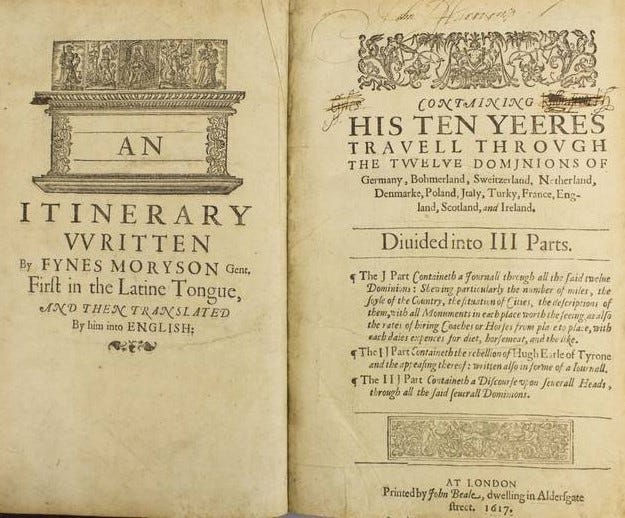
His three-volume book, snappily entitled An Itinerary: Containing His Ten Years Travel Through the Twelve Dominions of Germany, Bohemia, Switzerland, Netherland, Denmark, Poland, Italy, Turkey, France, England, Scotland and Ireland is known for its meticulous detail on daily life, local conditions, customs, costs and currency right across Europe and the Middle East.
With no other reason except an “itching desire” to see the world, Fynes essentially took one of the first documented ‘Grand Tours’ (which later became all the rage for affluent Victorians). He left England in May 1591 and proceeded to tick off a serious number of countries, even studying for a time at the universities of Basel, Leiden, Wittenberg and Padua (and learning to speak Dutch, Italian, German and French along the way, an unusual talent for a sixteenth century gentleman).
Although published later in his life (in 1617 rather than in 1593 when he actually visited the places), Fynes was deliciously obsessive in his detail, recalling and detailing every morsel of historical fact he came across. He mentions Prosecco twice in his travel writings, the first as he was crossing the Tagliamento River, which flows from the Alps to the Adriatic Sea at a point between Trieste and Venice, becoming the first person to explicitly use the wine’s modern name in literature.
“Histria is devided into Forum Julii, and Histria properly so called… Here growes the wine Pucinum, now called Prosecho, much celebrated by Pliny”.
This neatly backs up the long-standing Roman connection, of course. The next reference, 23 pages later, includes Prosecho in a list of Italy’s best and most famous wines – showing how high a regard it was held in the sixteenth century.
"These are the most famous Wines of Italy. La lagrima di Christo and like wines neere Cinqueterre in Liguria: La vernazza, and the white Muskadine, especially that of Montefiaschoni in Tuscany: Cecubum and Falernum in the Kingdom of Naples, and Prosecho in Histria”.
For the next official reference in literature, we need to fast forward to 1754, the heart of the Enlightenment period in Italy. A poet called Aureliano Acanti writes passionately about the wines of the Veneto region in his compendium called Il Roccolo ditirambo, The Bird-Catching Dithyramb.

(Interestingly, Aureliano Acanti was a pseudonym and anagram of the author’s real name, which was Valeriano Canati. A Venetian Catholic priest, he dedicated the work to Count Gelio Ghellini, patriarch of one of the most powerful families of Vicenza, on the marriage of his daughter Elena to Count Simandio Chiericati).
The Arcadian poem follows the exploits of Dionysus, the Greek god of wine, and sings the praises of Venetian winemaking. What makes it stand the test of time is its vivid descriptions of each wine’s colour, flavour and effect on the drinker – the first time an author had done so.
Acanti is the first to use the modern spelling of Prosecco, describing the wine as sweet and cloudy, but a pure and healthy wine.
There’s a beautiful and evocative line in the poem that clearly captures his joy, love and passion for Prosecco.
In Italian, it reads as: “Ed or ora immolarmi voglio il becco con quel meloaromatico Prosecco”. Which translates as: “And now I would like to wet my mouth with that apple-aromatic Prosecco".
He later talks about its appearance:
“From Monteberico this perfect / chosen Prosecco gives us the splendid / Our Canon. I know him / He is a little dark, and seems cloudy; / But nevertheless he is such a pure and healthy balm”.
Although the idea of a Prosecco being “dark and cloudy” seems odd today, it was the norm in the eighteenth century – it would have been made rustically, lightly sparkling and unfiltered, with the lees (yeast) left to finish fermenting in the bottle, giving it a cloudy appearance.
About 20 years later, in 1772, Prosecco was officially linked with the unique growing area of Conegliano and Valdobbiadene for the first time. It was lauded by a Venetian nobleman, landowner, botanist, academic and winemaker called Francesco Maria Malvolti, who wrote an oenological report about the region.
"Who does not know how exquisite are our Marzeminos, Bianchettos, Proseccos, Moscatellos, Malvasias, Glossari and others, that are grown on various hills near here, when they are indeed made with the greater care required by these grape varieties and by the land where they are cultivated?”

Appearing in Volume VIII of the Giornale d’Italia, it is the first written documentation of the Prosecco grapes being grown in these steep, rolling hills, which we today consider the premium heart of Prosecco, and now hold the prestigious DOCG (Denominazione di Origine Controllata e Garantita) classification.
It’s an important reference and is considered the start of Prosecco’s rapid rise to prominence. Interestingly, in 1868, Francesco’s great-great-grandson Angelo Malvolti partnered with Italian scientist Antonio Carpenè to found the iconic Carpenè-Malvolti winery (which started out as the Società Enologica Provinciale), which still operates today.
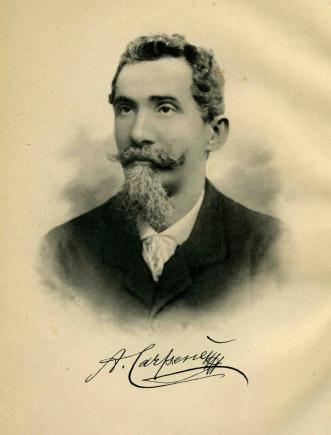
These are the viticultural heroes who eventually sent Prosecco stratospheric and cemented its worldwide status and success. They were obsessed with raising the wine’s reputation. When Antonio Carpenè founded the Società, he wanted it to be a forward-thinking organisation that modernised Italian winemaking, and his goal was to apply scientific methods to local Glera grapes to create an Italian sparkling wine that could rival French champagne.
Among the many improvements they made to the region’s winemakers were introducing standardised, scientific techniques and establishing vine nurseries that introduced new, disease-resistant grape varieties and pioneered the use of modern oenological equipment. So passionate was Antonio, that he was said to pass on his knowledge by holding open-air meetings with local growers that saw him ‘preaching in the piazza’.
In fact, under Carpenè and Malvolti’s guidance, the society’s wines were successfully showcased at the Vienna Universal Exposition in 1873, putting the region firmly on the global map.
The success of the society also inspired the foundation of Italy's first winemaking school, the renowned Scuola Enologica di Conegliano, which opened in 1876 and laid the groundwork for a lot of modern Italian viticulture.

A few years later, in 1895, Federico Martinotti, an Italian scientist and oenologist from the University of Asti invented and patented a secondary fermentation method that produced large volumes of mousse (soft bubbles) in large, closed steel tanks. Up until then, Prosecco’s bubbles had been formed in the bottle, like champagne. Federico’s idea was essentially to reduce the amount of time it took to make the wine sparkling, which was hugely time-consuming and luck-based without temperature-controlled fermentation. He fermented the wine in autoclaves, pressurised tanks that kept carbon dioxide trapped inside, making fresher, fruitier wines in a much shorter time.
Federico’s methods were later adopted and improved by Frenchman Eugène Charmat in 1910 who fitted the tanks with a propeller blade to mature wines in the tank after the mousse has been produced.

In 1924, Etile Carpenè, one of the sons of the Carpenè-Malvolti dynasty, became the first winemaker to officially market a wine with the word Prosecco on the label. It was a bold branding decision. Previously, they had been sold as ‘Italian Champagne’, but the new positioning not only legally associated it to a specific geographical territory but also gave it a distinct identity. It was an inspired decision, one that certainly led to the wine’s DOC recognition 45 years later in 1969 and perhaps even today’s DOCG status, which was created in 2009.
Today, Prosecco is one of the world’s undisputed sparkling wines, a success story rooted in over two thousand years of history. Over 660 million bottles are produced each year (more than double that of champagne), of which an astonishing 131 million are sent to the UK.
Modern and accessible, it’s a wine we reach for when we want something light, bright and joyful. Yet Prosecco is far from lightweight, with a history that’s rich and deep, a plethora of ancient poets and scholars singing its praises.
Prosecco is not champagne’s cheaper cousin. It never was.
It is Italy in a glass, sunlit hillsides, centuries of craftsmanship, literary romance and passionate makers poured into something effortlessly alive. And perhaps that is its greatest triumph: a wine with two thousand years of history that still feels utterly modern.
As the locals around Conegliano Valdobbiadene say, “saluti!”.


Comments