

First oat milk

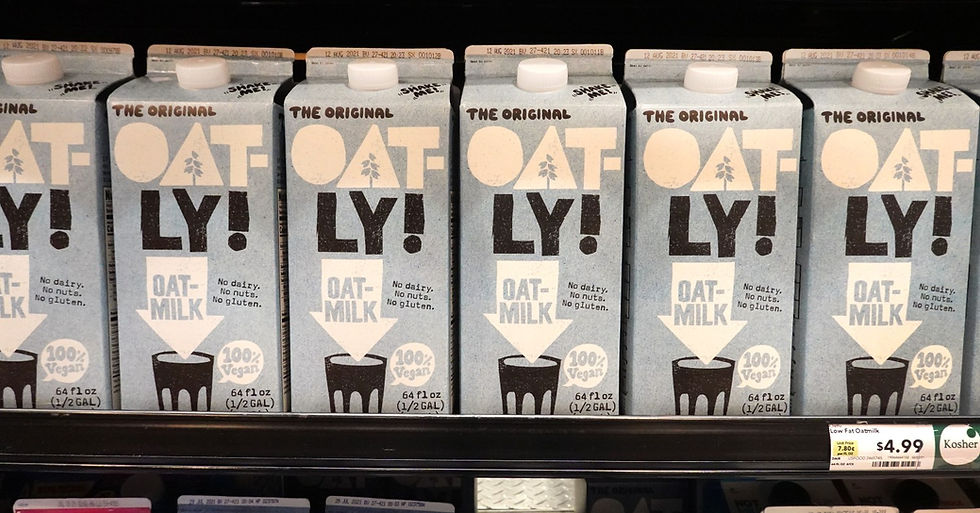
If you ask the internet when oat milk was first invented, it says with confidence and without hesitation, it was 1990. In Sweden. By a scientist called Rickard Öste. Who later founded a brand called Oatly with his brother Björn.
Yet humans have been eating oats for millennia, so how could it have possibly taken a curious race such as ours until very recent history to extract ‘milk’ from one of our favourite cereal crops?

After all, oat milk is essentially just the creamy, milky white liquid extracted from blending oats with water. And surely history, culture and literature are awash with references to some of our oat concoctions before it became a staple of flat whites in trendy coffee shops…
So, when and where was the first reference to water and oats being mixed? And what were the key stopovers on the long road to Oatly enlightenment?
It turns out, the story begins a tad before 1990. Actually, quite a long time before. Before farming even.
Archaeologists working at a site in Grotta Paglicci in Puglia, southern Italy, discovered an ancient stone implement (a kind of grinding tool) which they believe dates back around 32,000 years. Although the tool was dug up in 1989, it was only scientifically analysed between 2010-2012 – and the results were extraordinary.
Advanced washing techniques showed evidence of five different plant starches on its stone surface, primarily wild oats, the earliest known timescale for our Upper Palaeolithic hunter-gatherer ancestors eating oats in Europe (predating formal farming by roughly 20,000 years). It means oats may have one of the oldest culinary histories of any grain.

Researchers think that this oat flour would have been mixed with water to make a type of nutritious gruel. And what is gruel but the thicker, lumpier ancestor of today’s oat milk?
Yet despite oats being a Stone Age staple for Homo sapiens, the cereal subsequently suffered a bit of a reputational PR problem in later history.
The ancient Greeks and Romans largely regarded oats as animal feed, uncivilised and unfit for human consumption. Wheat and barley were the superior cereals of the civilised Roman, whereas oats were fed to horses.
In the first century, Pliny the Elder noted in Book 18 of his epic Natural History encyclopaedia (Naturalis Historia) that oats were essentially a weed that only grew well when other crops failed.
He wrote that “the first of all forms of disease in wheat is the oat” and that even barley “degenerates into oats”. He believed this occurred primarily due to damp soil and climate, or weak, rotting seed. He also took care to mention that the uncouth “dark tribes in the cold north” of Germany “made their porridge of nothing else”. It was a pointed status play, a food-based commentary on their intellectual, evolutionary and culinary inferiority.

He did however, like Greek writers before him, admit that oats were highly regarded for their therapeutic properties. Hippocrates, the father of medicine himself, recommended oat-based poultices, gruels or teas to soothe stomach issues, treat diarrhoea, ease liver ailments and relieve respiratory and skin conditions. They believed oats could adjust a patient's vital fluids and internal humours, with treatments scaled directly to the severity of a patient’s illness.
- For mild cases & convalescence, thick and hearty oat gruels were prescribed
- For moderate fevers and more acute conditions, water extracted from boiled oats was made
- For severe illness or high fevers, thin diluted oat water was used (does this sound like oat milk?)
Oat poultices (which were warm or even hot) would have been applied to a patient’s skin to help with localised pain, swellings or sores, the grain believed to draw out inflammation, soothe irritated nerves and soften hardened tissues.
The irony is that while oats were thought of as being inferior, eaten almost exclusively only by the “unwashed”, the ill, the very poor and horses, science has since proved how remarkably nutritious these meals would have been! Low in calories, oats are rich in protein and packed with antioxidants, vitamins and minerals like B1, B5, manganese and magnesium. They lower blood pressure, reduce cholesterol, aid digestion and may even help reduce heart disease and diabetes.

Yet oats remained the poor cousin of wheat and barley for centuries. Flash forward to the 17th century and oats appear in the medical treatise called Ars Chirurgica: A Compendium of the Theory and Practice of Chirurgery by controversial English physician William Salmon. Written in 1698, it details the surgical practices, instruments, and medicinal treatments of its time, becoming a foundational guide for early modern medicine, one of the first comprehensive practical medical handbooks published in English.
Like the Greek and Roman doctors before him, Salmon championed the medicinal benefits of oats, writing that “made into Water Gruel, or Milk Porridge, they certainly open and loosen the belly.”
He variously describes the gruel as a gentle, easily digestible liquid nourishment, again specifically prescribed to sustain patients weakened by illness, surgery or severe bloodletting. It was typically made by boiling oats in water, mashing or steeping them, and straining out the fibrous solids to leave behind a thick, creamy, milky liquid.
Salmon was an early influencer and advocate for the healthcare of the poor. His medical books were widely read and owned by respected men like Isaac Newton, Daniel Defoe (who wrote Robinson Crusoe in 1719) and Samuel Johnson (of Dictionary fame).
Around this time, oats were also starting to be forcibly given to sailors in the Royal Navy, which didn’t go down too well. In 1691, the navy ordered that oatmeal “could be issued in lieu of fish, 1 gallon of oatmeal being reckoned equivalent to 1 cod”, specifically on Wednesdays, Fridays and Saturdays. It was a substitution that “was reluctantly accepted in official circles and aroused open opposition among the men.”
Later, in his famous dictionary, published on 15th April 1755, Samuel Johnson amusingly defined oats as:
“A grain, which in England is generally given to horses, but in Scotland supports the people.”

It is a well-known jibe against the Scots, whom he disliked, despite his friend, travelling companion and later biographer, James Boswell, being Scottish. In The Life of Samuel Johnson (1791), Boswell claims to have replied: “Aye, and that’s why England has such fine horses, and Scotland such fine people.” Mic drop.
But at the heart of the joke is a truth. Scotland's wetter and colder climate was ideal for oats and less suitable for wheat. So over time, Scots developed an entire cuisine around the grain: oatcakes, porridge, brose, bannocks, skirlie, cranachan and haggis amongst other delicacies. It was well documented that Scottish soldiers had been carrying oats on military campaigns since the 14th century, with accounts describing them mixing oatmeal with water from streams while on the move.
But perhaps the strongest historical candidate for being an early version of oat milk was sowans. For centuries it was a common Scottish food made from the husks and layers left after milling oats. The husks were soaked in water for several days and allowed to ferment naturally. Once the mixture had soured, the liquid was strained away from the solids, left to settle before the clear liquid was poured off.

What remained was a starchy oat-rich sediment that could be consumed as a sour gruel or further made into other foods. Water. Oats. Fermentation. Straining. Separation. A drinkable oat extract. The technology was ancient, but many of the principles are recognisable.
Robert Burns, the renowned Scots poet, even immortalised sowans in his poem Halloween (published 1786).
“Till butter'd sowans wi' fragrant lunt, Set a' their gabs a-steerin.”
Roughly translated, it means: the fragrant steam from buttered sowans had everyone salivating.

Back in Victorian England, oat recipes became a symbol and shorthand for extreme poverty, starvation and miserliness. Think Oliver Twist. Written by Charles Dickens in 1838, he writes about oat gruel being given to workhouse orphans and as the cheapest meal possible.
“Three meals of thin gruel a day, with an onion twice a week, and half a roll on Sundays.”
In A Christmas Carol (1843) Scrooge settles down with a “low fire which was scarcely sufficient” and a “very small saucepan of gruel” on the hob (but we are told he was nursing a head cold – showing its medicinal properties again!).
Gruel was not oat milk of course, but it occupied a similar place – it’s made from oats and water and is super nourishing.
The main difference was texture.
Anyone who has left porridge (or gruel) sitting in a bowl knows what happens. Oats contain huge quantities of starch. Add water and heat, and those starches swell into a thick gel. Which is delicious if you're making breakfast. Less so if you're trying to make a latte.
Modern consumers wanted something that behaved like more like milk than something they needed to eat with a spoon. And that required science.
The modern story began in the 1980s at Lund University in Sweden. Food scientist Rickard Öste was researching lactose intolerance. A researcher at Kemicentrum, the centre for chemistry and chemical engineering at the university, he wondered whether oats might provide an alternative for millions of people struggling to digest dairy products. Spoiler: he was right.

It was at a conference in Japan in 1985 that Rickard first came across soy milk. It sparked the idea that it was possible to create a product that tasted like milk but was made from something else. Barley milk didn’t taste nice. Nor rye milk. So he started experimenting with oats.
Oats contain around 50-60% starch, so (as we know) if you blend oats and water together, you get something closer to wallpaper paste than milk. Rickard’s breakthrough came when he started using enzymes called alpha-amylases. To use a crude analogy, if starch molecules were an enormous chain made of thousands of linked units (which makes the texture thicker), then the alpha-amylase are like a molecular pair of scissors, cutting those chains into much smaller fragments – making the liquid thinner, giving it a natural sweetness and finally making it drinkable.

This process was called enzymatic hydrolysis and it was the first time oats had been transformed into something that genuinely behaved like milk.
Without going into too much detail, the process of transforming a bunch of oats into oat milk is as follows (apologies to all scientists reading this for its simplicity):
Cleaned oats that are de-hulled and heat-treated to prevent spoilage. They are then mixed with water and ground into a fine slurry (sounds nice, huh?). This is comes when the alpha-amylase enzymes are added and the mixture is held at carefully controlled temperatures – and over several hours, the starches are broken down into smaller carbohydrates. The resulting liquid is then pumped into industrial centrifuges and spun at high speed, separating the insoluble oat solids from the liquid oat base.
At this point the liquid contains proteins, soluble fibre, carbohydrates and natural oat flavour. But it still doesn't quite resemble milk. So oat milk makers usually add small amounts of vegetable oil to create creaminess, along with vitamins and minerals such as calcium, vitamin D and vitamin B12. This mixture is then forced through a high-pressure homogeniser, which breaks oil droplets into microscopic particles and disperses them evenly throughout the liquid. Without this step, the oil would simply float to the top.
Finally, the oat milk is sterilised using ultra-high-temperature treatment, heated to around 140°C for just a few seconds before being rapidly cooled and packed into sterile cartons. The result is shelf-stable for months.
Unlike a bowl of watery gruel on your kitchen table.
Rickard Öste and his colleagues patented the process in 1990. And on 17th February 1994, he and his brother Björn founded Oatly (originally called Ceba AB).
Funnily enough, one of oat milk's greatest strengths turned out to be something its inventors had not originally set out to achieve. It worked brilliantly in coffee.

Unlike many plant-based alternatives, oat milk steamed well, created stable foam that complemented rather than overwhelmed the flavour of espresso.
So from a marketing perspective, Oatly adopted an unusual strategy. Instead of trying to win over supermarket shoppers first, it targeted coffee baristas. If a customer enjoyed an oat milk latte in their favourite café, they surmised, they were far more likely to buy a carton for home.
It was a remarkably effective approach. By the late 2010s oat milk had gone from specialist health-food product to mainstream phenomenon. And Oatly had become a household name.
Which all goes to prove that the drink in our coffee mugs is simultaneously one of humanity's oldest ideas and one of its newest. An oat flour and water mix was first made tens of thousands of years ago, but it took a Swedish scientist to perfect the pouring consistency.
We know soy milk has roots stretching back centuries in East Asia, almond milk first appeared in medieval recipes and coconut milk has been used throughout history in tropical regions. But oat milk, by contrast, is essentially a child of modern food science.
It's a reminder that some drink ‘firsts’ are not always ancient. Some are even younger than the internet you looked this fact up on.
The final word must belong to the brilliant Rickard Öste, who’s now in his late 70s. He is professor emeritus in Lund University’s Department of Food Technology, Engineering and Nutrition and won the prestigious Polhem Prize in 2021, a Swedish award for creating a high-level technological innovation or an ingenious solution to a technical problem. Technical indeed – and one that has made life easier for millions of lactose-intolerant people around the world.
Please raise your oat milk lattes high in recognition of a true modern drink’s innovator!



Comments